Technik Engenharia offers complete multidisciplinary engineering solutions, covering all stages of a project's cycle - from conception and feasibility studies to commissioning and start-up of industrial units. Our approach combines technical knowledge, innovation and practical experience to guarantee safe, efficient and economically sustainable results.
With a team of highly qualified and experienced professionals, Technik works in various areas of engineering, sizing equipment, developing processes, detailing projects and three-dimensional modeling, always in compliance with national and international technical standards.
We use advanced simulation and calculation software, such as DWSIM, for simulating chemical and thermal processes, and PipeFlow Expert, for hydraulic analysis and balancing piping networks. These and other tools make it possible to predict the real behaviour of systems, optimize operating conditions and reduce implementation and operating costs.
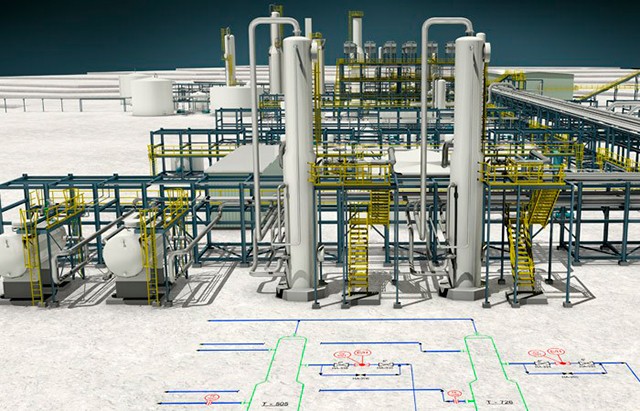
In the modelling and integration between disciplines, we apply BIM (Building Information Modelling) methodologies, which makes integrated project management possible, with automatic detection of interferences, better work planning and complete visualization of the industrial plant in a virtual 3D environment. This integration ensures greater precision, traceability and efficiency in project execution.
Our commitment is to deliver high-performance engineering, combining technology, methodology and practical experience to guarantee the success of each project. Technik acts as a strategic partner for its clients, transforming ideas into productive plants, from basic engineering to start-up, always with a focus on quality, safety and innovation.
conceptual engineering
Conceptual engineering is the first phase of an industrial project and its main objective is to assess the technical and economic feasibility of implementation. At this stage, process alternatives, available technologies and possible plant arrangements are studied in order to identify the best solution for the client. Simplified mass and energy balances are drawn up, as well as preliminary estimates of production capacity, comparative studies of process routes and the selection of critical equipment. The result is a global vision of the project, allowing scope, initial costs and deadlines to be defined, albeit with higher margins of uncertainty. This phase is essential for supporting strategic decisions, approving investments and reducing risks before moving on to more detailed stages.
In the conceptual phase of a project, deliverables include technical and economic feasibility studies, mass and energy balances, block diagrams, preliminary definition of key technologies and equipment, initial plant layout estimates and alternative arrangements. Preliminary lists of critical equipment and lines, estimates of electrical and energy consumption, civil infrastructure design and initial topographical studies are issued. Technik uses state-of-the-art software to carry out process and CAPEX simulations. This stage consolidates information for investment decisions with higher margins of uncertainty.

basic engineering
Basic engineering consolidates the choices made in the conceptual phase and deepens the definitions to reduce project uncertainties. Here, complete mass and energy balances, process flowcharts, preliminary equipment specifications, layout studies and definitions of materials and utilities required are developed. The detailing is not yet sufficient for construction, but it already makes it possible to prepare more accurate cost estimates, select strategic suppliers and plan the executive schedule. This phase also ensures that all disciplines - process, mechanical, piping, electrical, instrumentation and civil - are integrated in a coherent way. Thus, basic engineering acts as a link between the feasibility of the project and its execution, serving as a solid basis for the detailed stage.
The basic project deliverables include complete mass and energy balances using process simulators, process flow diagrams (PFDs), simplified engineering flow diagrams (P&IDs), preliminary equipment sizing, conceptual plant layouts, preliminary specifications for materials and utilities. It also includes initial instrument lists, single line power diagrams, piping class definitions, civil load studies and structural arrangements. This phase generates sufficient documents for more accurate cost estimates, planning deadlines and starting to contract strategic suppliers for equipment, materials and services.

detailed engineering
Detailed engineering is the final stage in the development of the project and aims to provide all the technical documents necessary for the construction, assembly and operation of the plant. At this stage, each discipline is delved into at an executive level: piping and instrumentation diagrams (P&IDs), equipment manufacturing drawings, 3D piping models, electrical diagrams, cable lists, instrumentation mesh diagrams, foundation plans and civil structures are drawn up. The entire project is handled with maximum precision, reducing uncertainties and guaranteeing safety, quality and operational efficiency. The documents issued during this phase are used directly by suppliers, construction companies and assembly teams, serving as a guide for field execution and commissioning. It is, therefore, the practical materialization of the project in a position to be implemented.
In the detailed engineering phase, all the executive technical documents necessary for the construction, assembly and operation of the industrial plant are produced. The process includes complete piping and instrumentation diagrams (P&IDs), final equipment data sheets and specifications for safety interlocks and control logic. In mechanics, manufacturing drawings are produced for vessels, tanks and heat exchangers, as well as reports on normative calculations and general arrangements for rotating machinery. The piping discipline delivers the consolidated 3D model of the plant, line isometrics with definitive lists of materials (MTO), flexibility studies and stress analysis reports. In electrical, single and triple line diagrams, cable lists, interconnection diagrams, cable tray plans and panel and substation specifications are issued. Instrumentation provides the final list of instruments, loop diagrams, control valve data sheets and complete I/O lists, as well as the automation architecture. Civil and structural deliver executive plans for foundations, concrete and steel sections and details, structural models and lists of materials. This stage is complemented by technical reports, descriptive memoranda, supply schedules and interfaces between disciplines, ensuring full integration. All of these deliverables provide secure and assertive conditions for purchasing, manufacturing, construction, commissioning and future operation of the plant.